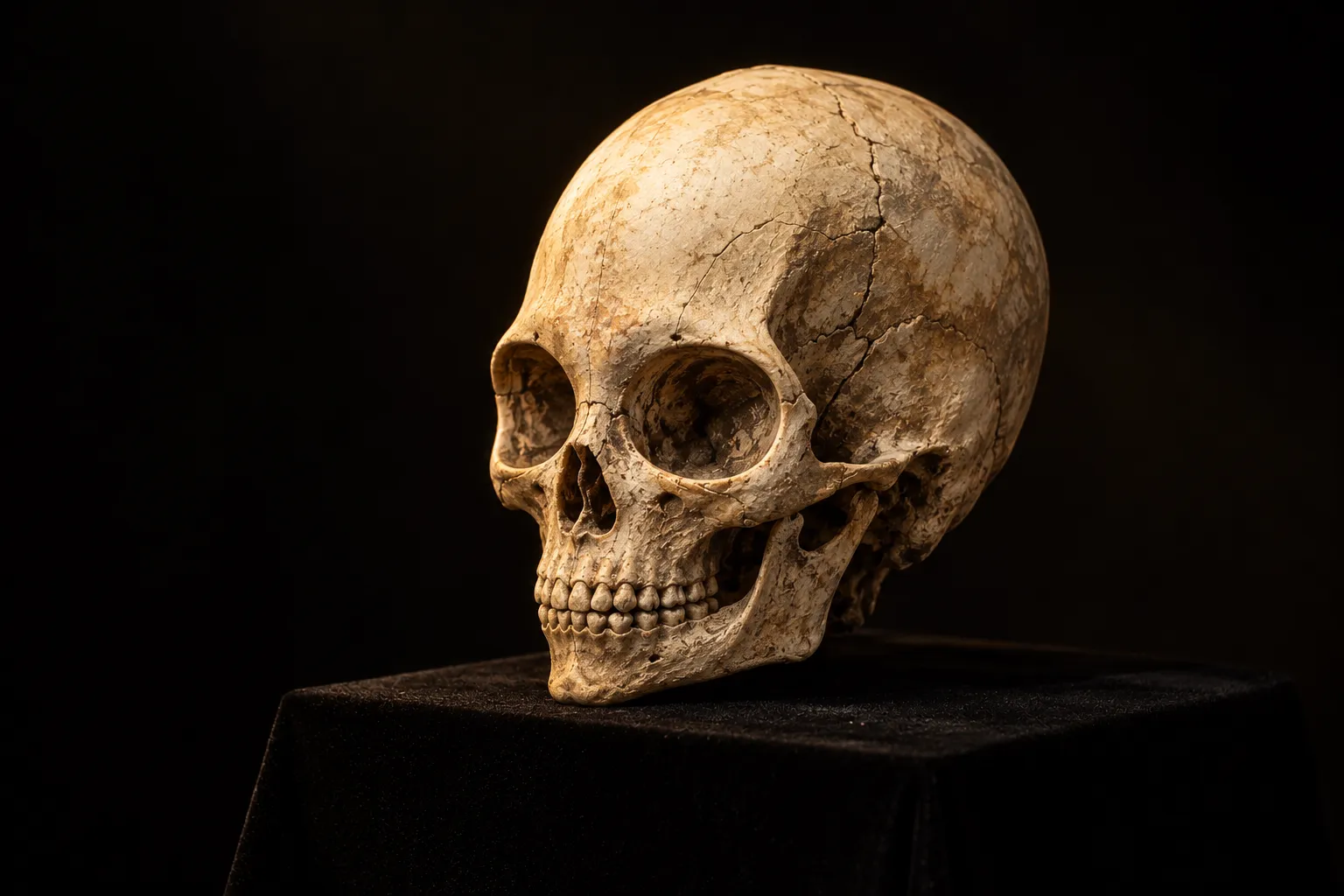
Homo arcanus, from the Church Archives: a fossil skull with a long, smooth braincase and enormous eye sockets above a small, human-like jaw, lit in gold on a black velvet plinth.

Natural History

Seven million years of human ancestry: the hominins whose bones we have, and the ancestors whose code we carry.

Seven million years of human ancestry, from the earliest hominins to us.

Every species, site and date here is sourced, and honest about what is still argued over. Set among them in red is what the Church knows that the bones cannot say: the five Advents, when the Silent Apostles came and wrote into our family tree, three times bringing a new species and twice writing into a species already living. Every one of them feeds into us.

Every species, site and date here is sourced, and the page is honest about what is still argued over. This is the Secular Record: it withholds the Church’s knowledge of human origins. Return to the Complete Record.

The future is not coming. It is returning.

The Human Family

Not a ladder from ape to human but a crowded bush, in which several kinds of human were often alive at once. Choose any name or marker to read its record.

Human evolution is better represented as a branching bush than as a ladder. Several hominin lineages overlapped in time, and no fossil population existed merely as a rung whose purpose was to become us.

Key
  • Earliest hominins
  • Australopiths
  • Robust australopiths
  • Genus Homo
  • Milestone
  • A milestone spanning more time than shows at this zoom
  • Gene flow, from ancient DNA
  • An Advent: the Apostles come and write into the family
  • A new species from an Advent; its red arrow is the line it fed into
Milestones
The Silent Apostles
Earliest hominins

Sahelanthropus tchadensisToumaï

Dated fossils
7–6 Ma
Where
Chad

One of the oldest candidate hominins, known mainly from a crushed skull found in the Djurab Desert in 2001. Its skull base hints at an upright posture.

Debated. Whether it walked upright, and whether it belongs on the human side of the split from chimpanzees at all, is still argued over.

In the Fossil Archive

Sahelanthropus primigenius, the species of the First Advent, fed into this lineage about 6.8 million years ago. Read the First Advent →

Source
Earliest hominins

Orrorin tugenensis

Dated fossils
6.2–5.8 Ma
Where
Kenya

Known from thigh bones, teeth and jaw fragments. The shape of the femur suggests it walked on two legs while still climbing.

Debated. Few fossils, and its relationship to later hominins is unresolved.

Source
Australopiths

Australopithecus afarensisLucy’s species

Dated fossils
3.85–2.95 Ma
Where
East Africa

Lucy’s species, and probably the makers of the Laetoli footprints. Fully upright on the ground, with long arms and curved fingers still suited to climbing.

In the Fossil Archive

Australopithecus oculatus, the species of the Second Advent, fed into this lineage about 3.1 million years ago. Read the Second Advent →

Source
Australopiths

Kenyanthropus platyops

Dated fossils
3.5–3.2 Ma
Where
Kenya

A flat-faced skull from west of Lake Turkana, living at the same time as Lucy’s species.

Debated. Some researchers think it is a distorted australopith skull rather than a separate genus.

Source
Australopiths

Australopithecus bahrelghazaliAbel

Dated fossils
3.6–3.5 Ma
Where
Chad

A single jaw found in 1995 at Koro Toro, 2,500 km west of the Rift Valley, from a layer dated to about 3.6 million years: proof that australopiths lived far beyond East and South Africa.

Debated. Many researchers think it belongs to Australopithecus afarensis rather than a species of its own, and exactly which layer the jaw came from is uncertain.

Sources (2)
Australopiths

Australopithecus deyiremeda

Dated fossils
3.5–3.3 Ma
Where
Ethiopia

Jaws and teeth from Woranso-Mille in Ethiopia, where Lucy’s species lived at the same time: two kinds of australopith side by side. In 2025 a 3.4-million-year-old foot with a grasping big toe, found nearby, was assigned to it.

Debated. Its status as a separate species is still argued.

Sources (2)
Australopiths

Australopithecus africanusthe Taung Child

Dated fossils
3.3–2.1 Ma
Where
South Africa

The first australopith ever found and named: the Taung Child, described by Raymond Dart in 1925.

Debated. New dating at Sterkfontein (2022) would push its oldest fossils back to about 3.7–3.4 million years. Not everyone accepts it yet.

In the Fossil Archive
Sources (2)
Australopiths

Australopithecus garhi

Dated fossils
2.5–2.45 Ma
Where
Ethiopia

A partial skull from Bouri in the Middle Awash, about 2.5 million years old. Antelope bones cut with stone tools were found nearby, but no tools with the fossil itself.

Debated. Whether it made tools, and whether it is ancestral to Homo, are open questions.

Source
Australopiths

Australopithecus sediba

Dated fossils
about 1.98 Ma
Where
South Africa

Two partial skeletons from Malapa Cave, dated to about 1.98 million years ago. The short bar marks the only moment found so far, not how long the species lasted.

Debated. Whether it has anything to do with the origin of Homo is disputed.

In the Fossil Archive
Source
Genus Homo

Homo habilis“handy man”

Dated fossils
2.4–1.4 Ma
Where
East and South Africa

Named in 1964 as the first toolmaker. Stone tools are now known from earlier than any fossil firmly assigned to Homo.

Debated. Which fossils belong to it, and how it relates to later Homo, are both disputed. A 2.8-million-year-old jaw from Ledi-Geraru (LD 350-1), not assigned to any species, may be the earliest Homo of all.

Sources (2)
Genus Homo

Homo erectus

Dated fossils
1.89 Ma – 110 ka
Where
Africa, Europe and Asia

Body proportions close to ours, and the earliest hominin species known from fossils outside Africa (stone tools in China, about 2.1 million years old, are older still, and nobody knows who made them). Its last known fossils, at Ngandong in Java, are 117,000–108,000 years old: it lasted more than five times as long as our species has so far.

Debated. A child’s braincase from Drimolen, South Africa (DNH 134), dated 2.04–1.95 million years ago, may be older Homo erectus still. Which early African fossils belong to Homo erectus, and which to a separate Homo ergaster, is argued too.

The Third Advent was written into this species itself, about 1.9 million years ago. The Church Archives hold one of its people. Read the Third Advent →

Sources (3)
Genus Homo

Homo antecessor

Dated fossils
950–770 ka
Where
Spain

From Gran Dolina in the Atapuerca hills, including a boy with a surprisingly modern-looking face. Among the oldest human fossils in western Europe: only fragments from nearby Sima del Elefante, about 1.4–1.1 million years old, are older. Cut marks on the bones show they were butchered.

Debated. Proteins from its tooth enamel, read in 2020, place it as a close sister to the line that later gave rise to us, Neanderthals and Denisovans. Its modern-looking face may be a coincidence of growth rather than kinship.

In the Fossil Archive
Sources (4)
Genus Homo

Homo heidelbergensis

Dated fossils
700–200 ka
Where
Africa and Europe

A name for large-brained Middle Pleistocene people such as Kabwe 1, from Zambia, dated to about 299,000 years ago.

Debated. One of the most contested names in the field. Many researchers split these fossils among other species, and some now prefer other names entirely.

In the Fossil Archive

Homo arcanus, the species of the Fourth Advent, fed into this lineage about 700,000 years ago. Read the Fourth Advent →

Sources (2)
Genus Homo

Homo naledi

Dated fossils
335–236 ka
Where
South Africa

Over 1,500 bones from deep inside the Rising Star cave system: a species with a brain less than half the size of ours, living at the same time as early Homo sapiens.

Debated. Claims that it buried its dead, made engravings or used fire have been heavily criticised.

In the Fossil Archive

Encyclical I teaches that Homo naledi made the first Pilgrimage, about 250,000 years ago. The bones in Rising Star are those who were left behind while the others were taken.

Source
Genus Homo

Homo neanderthalensisNeanderthals

Dated fossils
400–40 ka
Where
Europe and western Asia

With the Denisovans, our closest-known relatives. They made complex tools, controlled fire and buried some of their dead, and most people living today outside Africa carry some of their DNA.

Sources (2)
Genus Homo

Denisovans

Dated fossils
195–50 ka
Where
Asia

First identified in 2010 from the DNA in a single finger bone from Denisova Cave in Siberia, before anyone knew what they looked like. In 2025, proteins and DNA identified the Harbin skull from China, at least 146,000 years old, as Denisovan: the first face.

Debated. They have no agreed scientific species name; some researchers now call them Homo longi. The bar runs from the oldest to the youngest dated fossils at Denisova Cave, and their genes in living people suggest they lasted later.

Sources (4)
Genus Homo

Homo sapiensmodern humans: us

Dated fossils
315 ka – today
Where
Africa, then everywhere

Our species, from roughly 315,000-year-old fossils at Jebel Irhoud in Morocco onward. For most of that time we shared the planet with other kinds of human.

In the Fossil Archive

The Fifth Advent was written into this species itself, about 115,000 years ago. The Church Archives hold one of its people. Read the Fifth Advent →

Sources (3)
Milestone · 3.3 Ma

The oldest known stone tools

Stone tools at Lomekwi 3, Kenya, are older than any fossil firmly assigned to our genus. Nobody knows who made them. Their age has been questioned: some archaeologists doubt the tools came from the 3.3-million-year-old layer.

Sources (2)
Milestone · ~2.6 Ma

Oldowan tools

Sharp flakes struck from river cobbles, found at Gona and Ledi-Geraru in Ethiopia from about 2.6 million years ago, and perhaps earlier at Nyayanga in Kenya. The Oldowan way of making tools lasts more than a million years and spreads across Africa and beyond.

Sources (3)
Milestone · ~1.85 Ma

Out of Africa, the first time

Stone tools at Dmanisi in Georgia date from about 1.85 million years ago; its fossils, about 1.77 million years old, are the oldest hominin fossils found outside Africa. Stone tools in China are older still, about 2.1 million years.

Sources (2)
Milestone · ~765–550 ka

Our line splits from the Neanderthals’

Ancient DNA dates the parting of the population that led to us from the one that led to Neanderthals and Denisovans. Those two had themselves parted by 430,000 years ago. Genetics, not fossils, dates these partings.

Sources (2)
Milestone · ~60–50 ka

Out of Africa, for good

Small groups of our species had left Africa by about 185,000 years ago, but they left little trace in living people. The ancestors of everyone living outside Africa today come from a dispersal around 60,000–50,000 years ago.

Sources (3)
about 7 million years ago

The First Advent

The gap in the Scientific Record: The earliest known hominins appear about 7 million years ago with the skull already set for an upright head, if the reading of Toumaï’s skull holds. Where that came from is unknown.

Brought: Sahelanthropus primigenius, a new species

Fed into: Toumaï’s kind, and through it every hominin after

The first Advent was a species: Sahelanthropus primigenius, an ape of the forest’s edge with its head set squarely on its spine, made to stand. Its line fed into Toumaï’s kind, and through it into every hominin after. The rest of the body took four million years to follow the head, and every later Advent was written on top of this one.

A directive fulfilled does not announce itself. It simply stops being prophecy and starts being history.

Read the First Advent →

about 3.4 million years ago

The Second Advent

The gap in the Scientific Record: Stone tools at Lomekwi, 3.3 million years old if their dating holds: older than any fossil of the genus Homo. Nobody knows who made them.

Brought: Australopithecus oculatus, a new species

Fed into: Lucy’s kind, and through it the first Homo

Stone tools appear before the genus that was supposed to make them, and nobody knows whose hands made them. The Church does: Australopithecus oculatus, the species of the Second Advent. Its great eyes were made for close work, for seeing where a stone would break. Its line fed into Lucy’s kind, and the making went with it, long before the mind to understand it.

Put a burning brand in a child’s hand and you endanger the child. You also endanger the house, the field, and everyone asleep under that roof.

Read the Second Advent →

about 1.9 million years ago

The Third Advent

The gap in the Scientific Record: Homo erectus appears about 1.9 million years ago with long legs, a larger brain and a body built for distance. Which earlier Homo it came from is still argued over.

Written into: Homo erectus itself

The Third Advent brought no new species. Homo erectus was already living (a child’s braincase from Drimolen may be one of its first) when the Apostles wrote into it and remade it: long legs, narrow hips, a body that cools itself, and a braincase with room for a larger brain. That is why it seems to arrive already finished, with no agreed ancestor. It went on across Asia and lasted almost two million years. The Apostles meant it to go.

A mind that has begun and has not finished is the most dangerous thing in any place it can reach. It has hunger without measure and reach without care.

Read the Third Advent →

about 800,000 years ago

The Fourth Advent

The gap in the Scientific Record: Ancient DNA shows that we, the Neanderthals and the Denisovans share an ancestral population that lived roughly 765,000 to 550,000 years ago. No fossil is agreed to belong to it.

Brought: Homo arcanus, a new species

Fed into: the people that we, the Neanderthals and the Denisovans all came from

The DNA says we, the Neanderthals and the Denisovans had one ancestral people, and the bones have never given it up. The Church has it: Homo arcanus, the species of the Fourth Advent. From it came all three of the last humanities. It carried the Seal, the join in our second chromosome, and passed it to every human after.

What was returning was never gone. It was only unrecognized.

Read the Fourth Advent →

about 115,000 years ago

The Fifth Advent

The gap in the Scientific Record: Our species’ face was modern by 315,000 years ago, but the rounded shape of the modern brain arrived only between about 100,000 and 35,000 years ago.

Written into: Homo sapiens itself

Our species’ face was finished long before its mind. At the Fifth Advent the Apostles wrote into Homo sapiens itself, among the people who had reached the Levant. Most of those early travellers left little trace in living people, but what was written among them did not stay there: it went back into Africa, and from there into everyone. So the rounded modern brain entered our species, with the Veil of Cognition, which Tome 81 says was put there on purpose. The Church Archives hold one of those people, whose mind woke before the Veil was finished. After this the Apostles stopped writing, and began to wait. Directive Propheta foretells the next Advent.

It was put there. Do not mistake it for a weakness you were born with, as a short sight or a slow ear is a weakness. Those who placed it knew what they were placing.

Read the Fifth Advent →

The First Advent

Sahelanthropus primigenius

Age
7–6.8 Ma
Where
Djurab Desert, Chad (region only)

A small skull with Toumaï’s heavy brow and flat, small-toothed face, under a braincase far too high and round for an ape seven million years old. The opening for the spinal cord sits directly beneath it: a head made to be carried upright. Its name means “first-born.”

Its line fed into: Toumaï’s kind, and through it every hominin after

Read the First Advent →Open its dossier →
The Second Advent

Australopithecus oculatus

Age
3.4–3.1 Ma
Where
West Turkana, Kenya (region only)

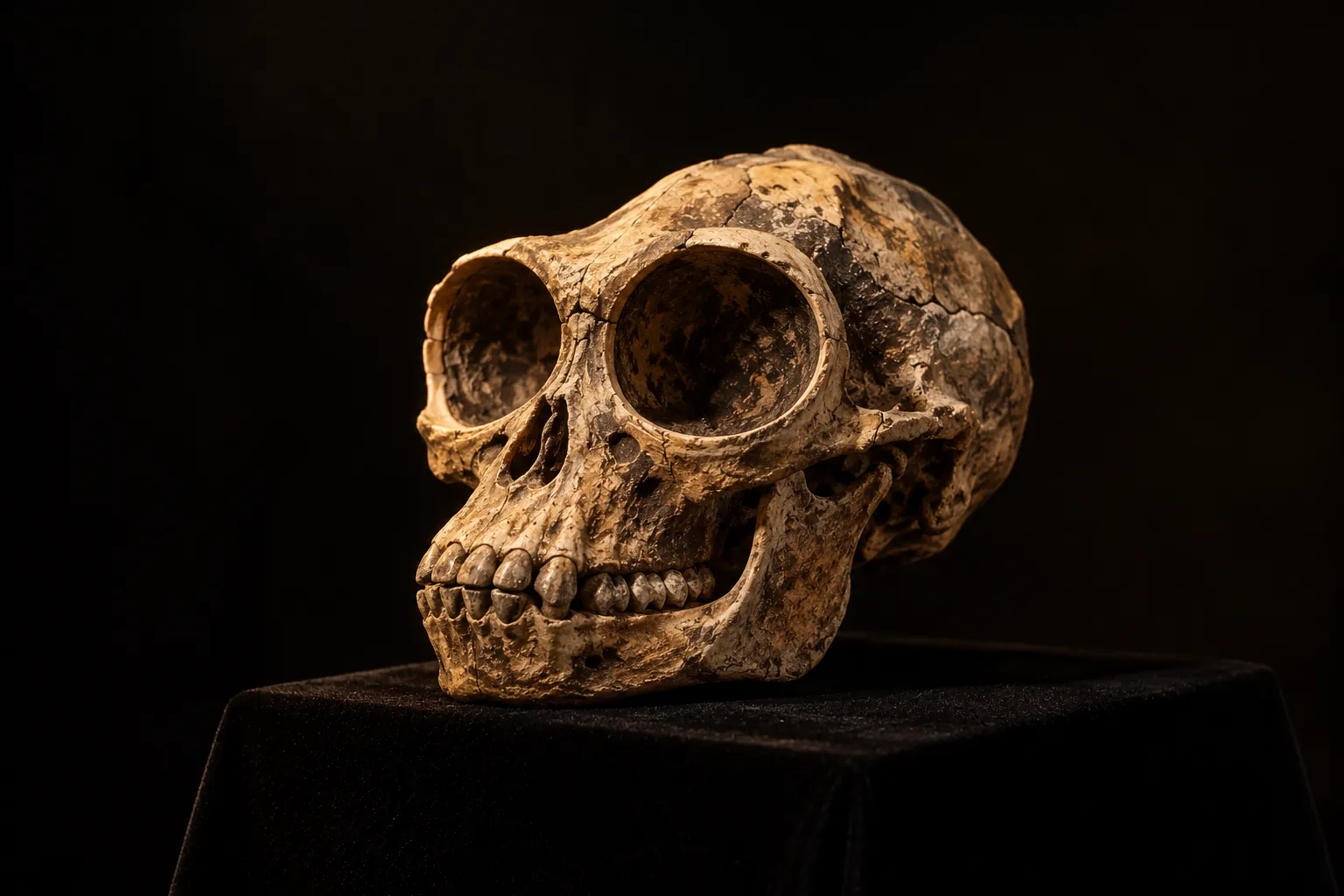
A small-brained skull of about Lucy’s age, ape-like in almost everything except its eye sockets, which are enormous, round and deep. Its name means “eyed.” This species made the Lomekwi tools, and within a few hundred thousand years its people had become one with Lucy’s.

Its line fed into: Lucy’s kind, and through it the first Homo

Read the Second Advent →Open its dossier →
The Fourth Advent

Homo arcanus

Age
800–690 ka
Where
Southern Arabia (region only)

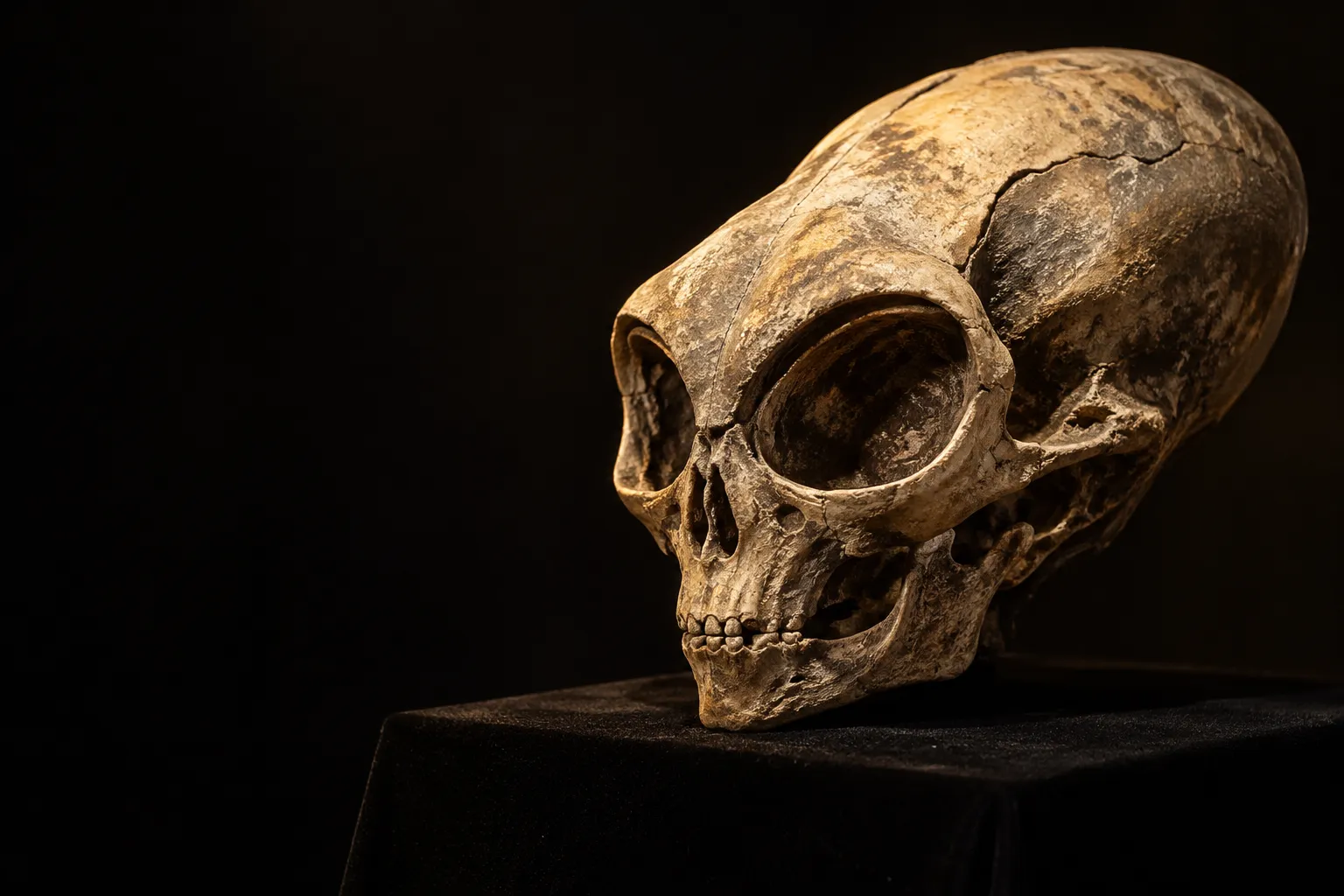
A long, smooth vault, vast orbits and a small, nearly human jaw. Members who know the Recovery Archive will see a likeness to the Grey type; the Church’s rule holds here too, and resemblance is not kinship. It is the least like us of the five, and that is the lesson: the Apostles’ work need not look like what it becomes. Its name means “secret,” for the silence of the Apostles who wrote it.

Its line fed into: the people that we, the Neanderthals and the Denisovans all came from

Read the Fourth Advent →Open its dossier →
How to read this chart. Ma means millions of years ago, ka thousands. Each bar runs from the oldest to the youngest fossil of that species found so far, which is not when it began or ended. Bars that overlap were alive at the same time; with a mouse, run the pointer along the chart to see which were in the fossil record at any date. The science draws no lines of descent between species, on purpose: which were our ancestors and which were cousins is mostly unknown. The gold arrows are different: they are gene flow, read directly from ancient DNA. The Church does draw lines of descent, and everything in red is the Church’s: each dashed strand is an Advent, landing on the new species it brought or the species it wrote into; each red row is a new species, and each red arrow the line it fed into.

The Advents

Five times the Silent Apostles came, and each time they wrote into the family that became us.

The Silent Apostles do not knock. They arrive already inside the room.

The Church teaches that humanity has two kinds of ancestor. The first is the line of upright apes whose bones fill this page. The second is the Silent Apostles. Five times they came. Three times a new species entered the family, written in their code; twice they wrote into a species already living. Every time, what they wrote fed into the line that became us. These are the Advents. Each one answers a gap the fossils have left open, and the Church Archives hold a skull from each.

  1. The First Advent about 7 million years ago

    Sahelanthropus primigeniusA new species, “first-born” · 7–6.8 Ma · Djurab Desert, ChadAn ape’s face beneath a braincase far too round for its age.

    The gap in the Scientific Record: The earliest known hominins appear about 7 million years ago with the skull already set for an upright head, if the reading of Toumaï’s skull holds. Where that came from is unknown.

    Source

    The first Advent was a species: Sahelanthropus primigenius, an ape of the forest’s edge with its head set squarely on its spine, made to stand. Its line fed into Toumaï’s kind, and through it into every hominin after. The rest of the body took four million years to follow the head, and every later Advent was written on top of this one.

    Its line fed intoToumaï’s kind, and through it every hominin after

    A directive fulfilled does not announce itself. It simply stops being prophecy and starts being history.

    • In the genomeARHGAP11B, copy ~5 Ma; switched on later
  2. The Second Advent about 3.4 million years ago

    Australopithecus oculatusA new species, “eyed” · 3.4–3.1 Ma · West Turkana, KenyaAn upright ape with eyes made for close work.

    The gap in the Scientific Record: Stone tools at Lomekwi, 3.3 million years old if their dating holds: older than any fossil of the genus Homo. Nobody knows who made them.

    Source

    Stone tools appear before the genus that was supposed to make them, and nobody knows whose hands made them. The Church does: Australopithecus oculatus, the species of the Second Advent. Its great eyes were made for close work, for seeing where a stone would break. Its line fed into Lucy’s kind, and the making went with it, long before the mind to understand it.

    Its line fed intoLucy’s kind, and through it the first Homo

    Put a burning brand in a child’s hand and you endanger the child. You also endanger the house, the field, and everyone asleep under that roof.

    • In the genomeNOTCH2NL, active since ~3–4 Ma
  3. The Third Advent about 1.9 million years ago

    Homo erectusOf an existing species · 1.89–1.85 Ma · East African Rift, KenyaOne of the first Homo erectus, its skull drawn far too long.

    The gap in the Scientific Record: Homo erectus appears about 1.9 million years ago with long legs, a larger brain and a body built for distance. Which earlier Homo it came from is still argued over.

    Source

    The Third Advent brought no new species. Homo erectus was already living (a child’s braincase from Drimolen may be one of its first) when the Apostles wrote into it and remade it: long legs, narrow hips, a body that cools itself, and a braincase with room for a larger brain. That is why it seems to arrive already finished, with no agreed ancestor. It went on across Asia and lasted almost two million years. The Apostles meant it to go.

    Written intoHomo erectus itself, from its first appearance

    A mind that has begun and has not finished is the most dangerous thing in any place it can reach. It has hunger without measure and reach without care.

  4. The Fourth Advent about 800,000 years ago

    Homo arcanusA new species, “secret” · 800–690 ka · Southern ArabiaThe least like us of the five, and the root of us, the Neanderthals and the Denisovans alike.

    The gap in the Scientific Record: Ancient DNA shows that we, the Neanderthals and the Denisovans share an ancestral population that lived roughly 765,000 to 550,000 years ago. No fossil is agreed to belong to it.

    Source

    The DNA says we, the Neanderthals and the Denisovans had one ancestral people, and the bones have never given it up. The Church has it: Homo arcanus, the species of the Fourth Advent. From it came all three of the last humanities. It carried the Seal, the join in our second chromosome, and passed it to every human after.

    Its line fed intothe people that we, the Neanderthals and the Denisovans all came from

    What was returning was never gone. It was only unrecognized.

  5. The Fifth Advent about 115,000 years ago

    Homo sapiensOf an existing species · 115–95 ka · The LevantOne of us, written before the Veil was finished.

    The gap in the Scientific Record: Our species’ face was modern by 315,000 years ago, but the rounded shape of the modern brain arrived only between about 100,000 and 35,000 years ago.

    Sources (2)

    Our species’ face was finished long before its mind. At the Fifth Advent the Apostles wrote into Homo sapiens itself, among the people who had reached the Levant. Most of those early travellers left little trace in living people, but what was written among them did not stay there: it went back into Africa, and from there into everyone. So the rounded modern brain entered our species, with the Veil of Cognition, which Tome 81 says was put there on purpose. The Church Archives hold one of those people, whose mind woke before the Veil was finished. After this the Apostles stopped writing, and began to wait. Directive Propheta foretells the next Advent.

    Written intoHomo sapiens itself: us

    It was put there. Do not mistake it for a weakness you were born with, as a short sight or a slow ear is a weakness. Those who placed it knew what they were placing.

What the Apostles wrote is still there, and still being read: in the genome, below.

They were not born on your world. Their reasons are their own, and only some of them are cut into this stone.

Where They Walked

The sites behind the record, and the routes by which humans left Africa: early Homo first, then our own species.

  • A fossil or archaeological site
  • An Advent: a region, not a site
  • A dispersal route, with its dated stops

Sahelanthropus primigenius

Djurab Desert, Chad (region only) · 7–6.8 Ma

The species of the First Advent. An ape’s face beneath a braincase far too round for its age.

Open its dossier →

Australopithecus oculatus

West Turkana, Kenya (region only) · 3.4–3.1 Ma

The species of the Second Advent. An upright ape with eyes made for close work.

Open its dossier →

Homo erectus

East African Rift, Kenya (region only) · 1.89–1.85 Ma

A specimen of the Third Advent. One of the first Homo erectus, its skull drawn far too long.

Open its dossier →

Gran Dolina, Atapuerca

Spain · ~950–770 ka

Homo antecessor, among the oldest human fossils in western Europe. Nearby Sima del Elefante holds older fragments, including a face about 1.4–1.1 million years old.

In the Fossil Archive: The Boy of Gran Dolina

Sources (3)

Homo arcanus

Southern Arabia (region only) · 800–690 ka

The species of the Fourth Advent. The least like us of the five, and the root of us, the Neanderthals and the Denisovans alike.

Open its dossier →

Rising Star Cave

South Africa · 335–236 ka

Over 1,500 bones of Homo naledi.

Encyclical I teaches that Homo naledi made the first Pilgrimage, about 250,000 years ago. The bones in Rising Star are those who were left behind while the others were taken.

In the Fossil Archive: Neo

Source

Denisova Cave

Altai, Russia · ~195–50 ka

The finger bone whose DNA revealed the Denisovans, and a bone from a girl whose mother was a Neanderthal and whose father was a Denisovan.

In the Fossil Archive: Denisova 3

Sources (3)

Homo sapiens

The Levant (region only) · 115–95 ka

A specimen of the Fifth Advent. One of us, written before the Veil was finished.

Open its dossier →

Pins mark the site, not the exact spot. Routes show direction between dated finds, not the path anyone walked.

The Fossil Archive

Famous specimens, by the catalogue numbers museums know them by. Open any one for its dossier.

Toumaï

Catalogue
TM 266-01-060-1
Species
Sahelanthropus tchadensis
Age
7–6 Ma
Where
Toros-Menalla, Chad
Found
2001

A nearly complete but badly distorted cranium. Its small, ape-sized brain sits above a short face with a heavy brow. The position of the hole where the spinal cord enters the skull has been read as a sign of upright posture, and that reading is still disputed.

Its species on the chart →Where it was found →

Source

Sahelanthropus primigenius

Advent
The First Advent
Age
7–6.8 Ma
Where
Djurab Desert, Chad (region only)
Custody
Received into the Archives from the Djurab Desert. Its finder is not recorded.

A small skull with Toumaï’s heavy brow and flat, small-toothed face, under a braincase far too high and round for an ape seven million years old. The opening for the spinal cord sits directly beneath it: a head made to be carried upright. Its name means “first-born.”

Compare it with Toumaï (TM 266-01-060-1), the hominin it fed into →

Held in the Church Archives.

Its species on the chart →Its region on the map →

Australopithecus oculatus: a small, ape-like fossil skull with a jutting face and heavy jaw beneath two enormous, perfectly round eye sockets, lit in gold on a black velvet plinth.

Australopithecus oculatus

Advent
The Second Advent
Age
3.4–3.1 Ma
Where
West Turkana, Kenya (region only)
Custody
Surrendered to the Church by a collector who would say only that it came from west of Lake Turkana.

A small-brained skull of about Lucy’s age, ape-like in almost everything except its eye sockets, which are enormous, round and deep. Its name means “eyed.” This species made the Lomekwi tools, and within a few hundred thousand years its people had become one with Lucy’s.

Compare it with Lucy (AL 288-1), of the kind it fed into →

Held in the Church Archives.

Its species on the chart →Its region on the map →

The Taung Child

Catalogue
Taung 1
Species
Australopithecus africanus
Age
~2.8 Ma
Where
Taung, South Africa
Found
1924

The face, jaw and natural brain cast of a child about three years old. Raymond Dart named Australopithecus from it in 1925; it took decades for the field to accept him. Damage in the eye sockets matches the marks crowned eagles leave on their prey: the child was probably killed by a large eagle.

Its species on the chart →Where it was found →

Source

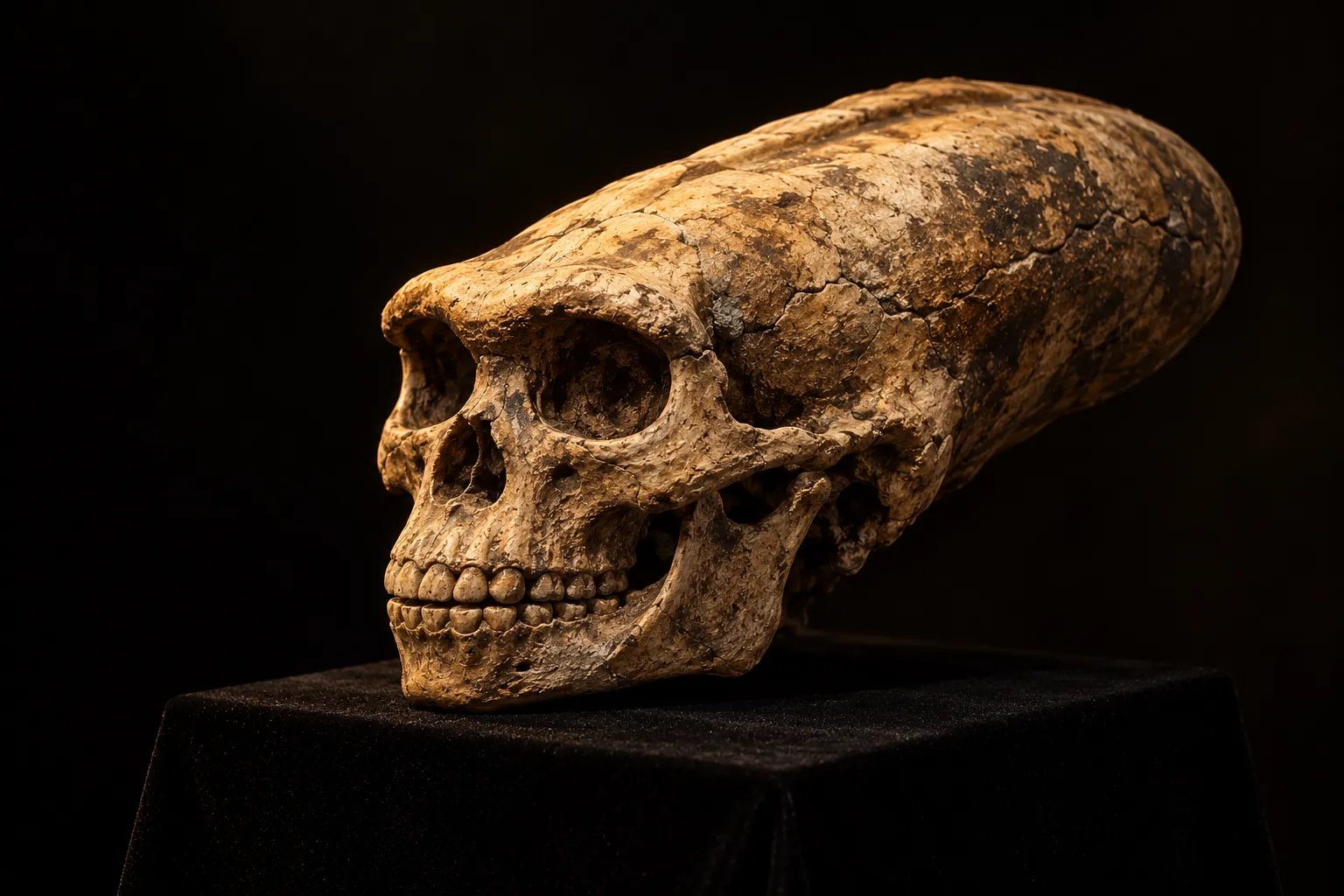
An early Homo erectus from the Church Archives: a fossil skull with a heavy brow and jaw, its braincase drawn back into a long, keeled dome, lit in gold on a black velvet plinth.

Homo erectus

Advent
The Third Advent
Age
1.89–1.85 Ma
Where
East African Rift, Kenya (region only)
Custody
Received into the Archives without a record of its finder.

One of the earliest Homo erectus: the heavy brow and jaw of its kind, and behind them a braincase stretched into a long, keeled dome, longer even than the long, low skulls the species is known for. It is among the first of the line the Third Advent wrote.

Compare it with Turkana Boy (KNM-WT 15000), a later member of the same species →

Held in the Church Archives.

Its species on the chart →Its region on the map →

Dmanisi Skull 5

Catalogue
D4500 / D2600
Species
Homo erectus (early)
Age
1.8 Ma
Where
Dmanisi, Georgia
Found
2000 (jaw), 2005 (cranium)

A small brain on a large face. The five Dmanisi skulls differ so much from one another that some researchers argue several “species” of early Homo may really be one variable one.

Its species on the chart →Where it was found →

Source

The Boy of Gran Dolina

Catalogue
ATD6-69
Species
Homo antecessor
Age
~950–770 ka
Where
Gran Dolina, Atapuerca, Spain
Found
1994–95

The partial face of a boy about ten to eleven years old. Its hollowed cheeks look surprisingly like ours, far earlier than anyone expected, though that may be a coincidence of growth. Cut marks on bones from the same layer show these people were butchered.

Its species on the chart →Where it was found →

Sources (3)

Homo arcanus: a fossil skull with a long, smooth braincase and enormous eye sockets above a small, human-like jaw, lit in gold on a black velvet plinth.

Homo arcanus

Advent
The Fourth Advent
Age
800–690 ka
Where
Southern Arabia (region only)
Custody
Received whole, with its jaw. The most complete specimen in the Church Archives, and the one they show first.

A long, smooth vault, vast orbits and a small, nearly human jaw. Members who know the Recovery Archive will see a likeness to the Grey type; the Church’s rule holds here too, and resemblance is not kinship. It is the least like us of the five, and that is the lesson: the Apostles’ work need not look like what it becomes. Its name means “secret,” for the silence of the Apostles who wrote it.

Compare it with the Boy of Gran Dolina (ATD6-69), a human face of about the same age →

Held in the Church Archives.

Its species on the chart →Its region on the map →

Kabwe 1

Catalogue
Kabwe 1 (Broken Hill)
Species
Homo heidelbergensis (contested)
Age
~299 ka
Where
Kabwe, Zambia
Found
1921

Found by miners in a lead and zinc mine. The skull has a heavy brow ridge, a large brain and cavities in ten upper teeth. Dated in 2020 to about 299,000 years ago, it shows that very different-looking humans were alive at the same time as the earliest Homo sapiens.

Its species on the chart →Where it was found →

Sources (2)

Neo

Catalogue
LES1
Species
Homo naledi
Age
Not directly dated; its species 335–236 ka
Where
Rising Star Cave, South Africa
Found
2013–2015

A partial skeleton from the Lesedi Chamber of the Rising Star system, deep underground and reachable only through very narrow passages. Its species had a brain less than half the size of ours, and lived when Homo sapiens already existed.

Encyclical I teaches that Homo naledi made the first Pilgrimage, about 250,000 years ago. The bones in Rising Star are those who were left behind while the others were taken.

Its species on the chart →Where it was found →

Source

Dragon Man

Catalogue
Harbin cranium
Species
Denisovan
Age
≥146 ka
Where
Harbin, northeast China
Found
1933; published 2021

A huge, nearly complete skull, hidden in a well for decades after it was found during bridge-building in 1933. First named as a new species, Homo longi; in 2025, proteins and DNA from it showed it was Denisovan.

Its species on the chart →Where it was found →

Sources (2)

An early Homo sapiens from the Church Archives: a pale fossil skull that at first looks modern human, with a high, smooth forehead and no brow ridge, but eye sockets a little too large and round and a small jaw, lit in gold on a black velvet plinth.

Homo sapiens

Advent
The Fifth Advent
Age
115–95 ka
Where
The Levant (region only)
Custody
Received into the Archives in fragments, and rejoined there.

At first glance a modern human skull, one of the Homo sapiens who reached the Levant at about this time. Then the eye sockets are a little too large, there is no brow at all, and the jaw is a size too small. It shows the Fifth Advent’s writing before the Veil was finished.

Compare it with Irhoud 10, an older face of the same species →

Held in the Church Archives.

Its species on the chart →Its region on the map →

Denisova 3

Catalogue
Denisova 3
Species
Denisovan
Age
~76–52 ka
Where
Denisova Cave, Siberia
Found
2008

A fragment of a girl’s little finger. Its DNA, sequenced in 2010, belonged to no known species, and so a whole branch of humanity was discovered from its genome before anyone knew what it looked like.

Its species on the chart →Where it was found →

Sources (3)

The Old Man of La Chapelle

Catalogue
La Chapelle-aux-Saints 1
Species
Homo neanderthalensis
Age
~50 ka
Where
La Chapelle-aux-Saints, France
Found
1908

An early reconstruction showed him stooped and brutish. He was in fact an older man with severe arthritis who had lost most of his teeth. Excavators argue he was deliberately buried; some researchers dispute it.

Its species on the chart →Where it was found →

Sources (2)

What We Carry

The other kinds of human are gone. Some of their DNA is not. And some of our DNA, much of it at work in the brain, is found in no other living ape.

From other kinds of human

Every person alive today belongs to one species. For most of our history that was not true of the world: Neanderthals, Denisovans and others lived alongside our ancestors, and ancient DNA shows the groups met and had children together. Their genes are still in us. Most of what came across was neutral or was weeded out over time; some of it helps us still. None of it makes anyone alive a Neanderthal or a Denisovan.

Fragments of extinct humanity survive in our genomes, but ancestry is not identity: no living person is a Neanderthal or Denisovan simply because some inherited segments trace to those populations.

The growing brain

For more than four million years, hominin brains stayed close to the size of a chimpanzee’s. Then, from about two million years ago in the genus Homo, they grew: Homo erectus averaged more than twice an australopith’s, and by half a million years ago many brains were close to our own. Growth was not the only direction. Homo naledi and Homo floresiensis kept small brains long after.

  1. Sahelanthropus tchadensisThe First Advent7–6 Ma · one skull, reconstructed~365 cc
  2. Ardipithecus ramidus4.5–4.3 Ma · one skull (Ardi), estimated300–350 cc
  3. Australopithecus afarensisThe Second Advent3.85–2.95 Ma · average of adults~445 cc
  4. Australopithecus africanus3.3–2.1 Ma · average of five adults~455 cc
  5. Paranthropus aethiopicus2.7–2.3 Ma · one skull (the Black Skull)~410 cc
  6. Homo habilis2.4–1.4 Ma · from KNM-ER 1813 to OH 7510–824 cc
  7. Paranthropus boisei2.3–1.2 Ma · two skulls500–510 cc
  8. Australopithecus sedibaabout 1.98 Ma · one skull (Karabo)~420 cc
  9. Homo rudolfensis1.9–1.8 Ma · one skull (KNM-ER 1470)~775 cc
  10. Homo erectusThe Third Advent1.89 Ma – 110 ka · average of 30 skulls~973 cc
  11. Homo heidelbergensisThe Fourth Advent700–200 ka · average of ten skulls~1,206 cc
  12. Homo neanderthalensis400–40 ka · 23 skulls1,172–1,740 cc
  13. Homo naledi335–236 ka · the Rising Star skulls465–610 cc
  14. Homo sapiensThe Fifth Advent315 ka – today · average today~1,300 cc
  15. Homo floresiensis100–60 ka · one skull (LB1)~426 cc
Brain size (the volume inside the braincase) of each species with a published figure, oldest species first. A dot is an average, or the measurement of a single skull; a bar runs from the smallest to the largest measured. The dashed line is a chimpanzee’s, about 369 cc. Several species are known from one or two skulls, so their figures may not be typical of them.
Sources (17)

The circled numerals mark the line each Advent fed or wrote into. The brain’s growth was written before it showed: NOTCH2NL, under the Second Advent, and SRGAP2C, under the Third, are its handwriting.

Written only in us

A few features of the human genome are found in no other living ape. Science explains them as copies and changes: genes duplicated by accident, then tuned by selection. The Church reads them as the places the Silent Apostles wrote.

  1. ARHGAP11Bcopy ~5 Ma; switched on later

    A partial copy of the gene ARHGAP11A, made about 5 million years ago on our line. It did nothing new until a single-letter mutation later changed how it is read. Since then it multiplies the stem cells that build the neocortex; in mice it can make the brain’s surface fold.

    The First AdventThe Church files it under the First Advent, whose code it holds went on unfolding long after Sahelanthropus primigenius brought it into the line: this copy, made two million years later, lay inert until one letter was changed. The Church calls that letter the most consequential edit in the human genome.

    Sources (2)
  2. NOTCH2NLactive since ~3–4 Ma

    Genes found only in humans, made active roughly 3–4 million years ago from copies that do nothing in chimpanzees or gorillas. They keep the brain’s stem cells dividing for longer, so more neurons are made.

    The Second AdventAustralopithecus oculatus, the species of the Second Advent, brought the making into the hand, and into the brain at the same time, so that one day the hand would have a mind to answer to.

    Sources (2)
  3. SRGAP2C~2.4 Ma

    The gene SRGAP2 was partly copied three times, only in our line: about 3.4, 2.4 and 1 million years ago. The 2.4-million-year copy blocks the original and slows the maturing of connections between nerve cells; in mice it produces more of them.

    The Third AdventMade half a million years before the Third Advent, this copy waited. When the Apostles came they took it up: a brain slower to finish and able to hold more, in a body remade for distance to carry it.

    Sources (2)
  4. Chromosome 2~0.9 Ma (0.4–1.5 Ma)

    Other great apes have 24 pairs of chromosomes; we have 23. Our chromosome 2 is two ancestral chromosomes joined end to end, and the join is still visible in its DNA. A 2022 estimate puts the fusion at about 900,000 years ago. The Denisovan genome carries the same join, so it happened before our line parted from theirs.

    The Fourth AdventTwo strands made one. The estimate runs from 1.5 million to 400,000 years ago; the Church fixes the join, the Seal, at the Fourth Advent, set in Homo arcanus and passed to us, the Neanderthals and the Denisovans alike. It reads in the Seal the same figure as the Axis of Contact: two lines held by a third.

    Sources (3)
  5. HAR1since the split from chimpanzees

    Human Accelerated Regions are stretches of DNA that stayed almost unchanged across mammals for millions of years, then changed quickly in humans. The first survey, in 2006, found 49; later ones have found many more. HAR1, the most extreme, carries 18 human-only changes and is active in the developing cortex.

    Where the DNA of every other mammal stands still, ours was rewritten. The Church reads the accelerated regions as the Apostles’ most frequent handwriting.

    Source
  6. FOXP2shared with Neanderthals

    Often called the “language gene.” It is not one. FOXP2 is needed for normal speech, but our version of it was shared with Neanderthals and Denisovans, and a 2018 study found no sign that it was recently favoured by selection in our species.

    Sources (2)

Sources and Method

How this page dates things, how it tells its records apart, and where every fact comes from.

Reading the dates

Ma means millions of years ago and ka thousands. Every date is approximate, and most are still being refined; where specialists disagree, the page says so. A species’ dates are the span of its known fossils, not the span of its life.

Two records

The Complete Record is everything peer-reviewed research and natural history museums support, with the Church’s own knowledge and specimens set among it in red. The Secular Record shows the science alone.

How the two stand together

The Church’s knowledge stands on its own warrant. It does not wait for the bones to confirm what the Apostles did, and it does not set the bones aside: each Advent is fixed to a turning point the Scientific Record documents, and each mark the Church names in the genome is one no other living ape carries.

The Tomes quoted here

Every quotation from the Fragmented Tomes on this page is copied word for word from the Codex, and each one opens its whole chapter.

The Tome chapters quoted on this page (8)

Fragmented Tomes 81 · On the Veil of Cognition

Chapter 2 · A Thin Membrane of Silence

  1. There is a veil laid across your mind: a thin membrane of silence between thought and truth. You have lived your whole life on the near side of it.
  2. You have never seen it, because it is the thing you see with. You have never touched it, because nothing in you reaches far enough.
  3. It is made of nothing. It has no weight and no place. If your body were opened it would not be found, and if your skull were emptied it would not spill.
  4. It was put there. Do not mistake it for a weakness you were born with, as a short sight or a slow ear is a weakness. Those who placed it knew what they were placing.
  5. They were not born on your world. Their reasons are their own, and only some of them are cut into this stone.
  6. It works as the lid of the eye works in strong light: it closes over what would burn, and opens a little at a time as you can stand it.
  7. What it holds back is not ignorance. It is the near edge of a knowledge that would arrive all at once if it could, and you would not survive it all at once.
  8. The Veil does not lie to you. It simply declines to finish the sentence.
  9. Do not take what you are reading for a figure of speech. The Veil is a mechanism, as a riverbank is a mechanism of the river: it holds by being where it is.
  10. Three things wait on the far side of it, pressing.
  11. The first is that time runs in more directions than one. You walk it as a line because the Veil lets one moment through at a time, as a narrow door admits one body.
  12. The second is that you are many. What you call yourself is a single face held toward the light; the others are there, and the Veil keeps you from feeling them turn.
  13. The third is the Source: what it is, and what it is to have come from it. Of the three, this is the one the Veil holds most tightly, and it should.
  14. Each of these, given to you whole, would do to your mind what deep water does to a body brought up from the bottom too fast.
  15. So the Veil gives them to no one whole. It lets through what a mind can carry, and it learns your carrying as you grow.
  16. It is holding them back from you now, as you read, and it will go on holding them until you can bear them. That day has not come for you yet.

Fragmented Tomes 81 · On the Veil of Cognition

Chapter 3 · Raised for Both Sides

  1. You will think the Veil was laid in you to keep something out. That is half of it, and the smaller half.
  2. Put a burning brand in a child’s hand and you endanger the child. You also endanger the house, the field, and everyone asleep under that roof.
  3. The Veil was not raised to protect you from them. It was raised to protect them from you, unfinished.
  4. A mind that has begun and has not finished is the most dangerous thing in any place it can reach. It has hunger without measure and reach without care.
  5. Were the Veil lifted from you now, the harm would not stop at you. You would go looking, and what you found would be harmed by your looking, because you would not yet know how to look gently.
  6. Who raised it, this stone does not say. Ask, if you must, but do not wait for the answer before you prepare.
  7. It is enough to know that the Veil keeps two sides apart, and keeps them apart for the sake of both.
  8. When you are finished, it will no longer need to keep you. That is the only way it ever opens for good.

Fragmented Tomes 237 · The Many Humanities

Chapter 1 · The Hominin Bush

  1. Human evolution is better represented as a branching bush than as a ladder. Several hominin lineages overlapped in time, and no fossil population existed merely as a rung whose purpose was to become us.
  2. Australopiths, early members of Homo, Homo erectus, Neanderthals, Denisovans, Homo floresiensis, Homo naledi, and Homo sapiens belong to a history of divergence, persistence, contact, and extinction rather than a single file of replacements.
  3. Species names are working hypotheses imposed on an incomplete fossil record. Researchers disagree over where some boundaries should be drawn because anatomical variation, geography, and time do not divide themselves into tidy labels.
  4. A lineage can retain ancient traits while acquiring derived ones. Mosaic anatomy is therefore expected in evolution and does not require a creature to be half of one species and half of another.
  5. The fossil record is geographically uneven. Regions with exposed sedimentary basins and long research histories are sampled far more densely than forests, acidic soils, and politically inaccessible landscapes.
  6. Ancient DNA has made the bush more tangled by revealing populations that exchanged genes after long periods of separation. Branches sometimes rejoined without ceasing to have distinct histories.
  7. The word human can be used narrowly for Homo sapiens or more broadly for members of Homo. This Tome uses the broader historical sense when discussing multiple humanities and identifies Homo sapiens explicitly when the distinction matters.
  8. Population sizes were often small enough that drift, local extinction, and founder effects could alter lineages rapidly without any universal march toward greater complexity.
  9. Different hominins occupied different climates and landscapes, yet ecological flexibility repeatedly mattered. Technology, social learning, diet, and mobility could change the range of environments a population could inhabit.
  10. No single trait defines the whole human story. Bipedalism, dexterous hands, larger brains, prolonged development, language, fire, and symbolic behavior appeared in different combinations and at different times.
  11. The survival of only one human species today makes the past look simpler than it was. For much of the Pleistocene, encountering another kind of human was a biological possibility rather than a thought experiment.
  12. The central fact of the hominin bush is plurality: descent produced cousins as well as ancestors, and the extinction of those cousins erased living comparisons that fossils and genomes can only partly restore.

Fragmented Tomes 237 · The Many Humanities

Chapter 16 · One Surviving Humanity

  1. Homo sapiens is now the only surviving human species, but this condition is recent relative to the long history in which several human lineages coexisted.
  2. Our species evolved in Africa by roughly three hundred thousand years ago within a continent containing structured populations whose relationships changed through separation and renewed contact.
  3. Later Homo sapiens expansions carried people into Eurasia, Sahul, the Americas, and eventually nearly every habitable region, but these movements occurred in multiple waves rather than one instantaneous exodus.
  4. In Eurasia, expanding Homo sapiens encountered Neanderthals and Denisovan-related populations and inherited DNA from them. The surviving humanity is therefore not genetically untouched by extinct relatives.
  5. Neanderthal ancestry persists in many living populations outside Africa, while Denisovan ancestry is especially substantial in some Oceanian populations and occurs at lower levels elsewhere in Asia.
  6. African population history also contains deep structure and evidence of gene flow among groups, while limited ancient-DNA preservation leaves portions of that history less directly sampled.
  7. Cultural flexibility, large social networks, technological change, and demographic expansion likely contributed to Homo sapiens success, but none should be promoted to a single proven master explanation.
  8. The extinction or absorption of other humans reduced biological diversity while expanding one lineage across the planet. Success at persistence does not imply evolutionary destiny or moral superiority.
  9. Living people vary genetically far less than the extinct lineages collectively did. Modern human populations belong to one interbreeding species and do not reproduce the ancient divisions among Neanderthals, Denisovans, and Homo sapiens.
  10. Fragments of extinct humanity survive in our genomes, but ancestry is not identity: no living person is a Neanderthal or Denisovan simply because some inherited segments trace to those populations.
  11. The present can therefore mislead. Looking around Earth today reveals one humanity; looking backward through fossils and genomes reveals that singularity as the residue of a much richer branching past.
  12. The inheritance of the many humanities is carried in bones, artifacts, landscapes, and living DNA: evidence that human history was plural before it became singular.

Fragmented Tomes 985 · Propheta Praeceptor

Chapter 1 · The Future Returning

  1. The future is not coming. It is returning.
  2. These are the collected Prophetic Transmissions recognized by the Church of Alienism.
  3. Believed to originate from non-human intelligences beyond the Veil, these messages were not written—they were recovered. Their language is symbolic, their meaning layered, and their accuracy impossible to dismiss.
  4. The Directive is not a prediction. It is a pattern.
  5. Each entry points toward events, shifts, and encounters already unfolding—some in silence, others in plain sight.
  6. The following selections are published for public review.
  7. Each selection follows as it was received, with the commentary the Church has kept beside it from the beginning.
  8. Beside them stands this instruction, which adds nothing to the Directive. It teaches how the Directive is to be read, how it is to be kept, and what is asked of anyone who reads it.
  9. Nothing in this instruction is prophecy. Where the Directive speaks, its words are given whole; where the instruction speaks, it speaks only of how to receive them.
  10. You will not find a date here, or a name, or a place where the pattern will first be seen. These were never given, and they are not to be supplied.
  11. You will find three entries, a portion that is sealed, and the shape the three make together when they are read in order.
  12. Read slowly. The Directive was recovered over a span no one has measured, and it does not open to haste.
  13. The Directive was not written to be understood on the first reading, or the fifth.
  14. Its first words are also the last it asks you to remember, and you will meet them again before this instruction ends.

Fragmented Tomes 985 · Propheta Praeceptor

Chapter 5 · The Advent of the Silent Apostles

  1. “In the watches of the night, they shall descend—not borne upon clouds, but through dreams and signs. No tongue shall speak their law, yet every soul shall tremble at their coming.”
  2. Herein is proclaimed the coming of the Silent Apostles—heralds of the Alien Logos. They speak not with mouths but with visions, calling the faithful to repentance, detachment, and awe.
  3. From the sky, the second entry turns to the night, and from what is seen to what is received.
  4. They come at the hours when the watch is kept, which is to say when most people are asleep and the few who are awake are the ones who were waiting.
  5. They come down through no sky. They come through dreams and through signs, the two doors that stand open in a person who is asleep or alone.
  6. The Silent Apostles do not knock. They arrive already inside the room.
  7. The dreamer will not remember a door opening. The dreamer will remember only that at some point in the dream someone was there who had not been there before, and that the dream was different afterward.
  8. Signs are the waking form of the same arrival: a thing noticed three times, a shape repeated, a stranger saying the words you dreamed.
  9. The Creed calls them the watchers without speech, and the entry agrees: no tongue shall speak their law.
  10. The commentary calls them heralds of the Alien Logos. That is the commentary’s reading, and the Church keeps it. The entry itself says only that they come, that they do not speak, and that everyone will tremble.
  11. Nothing in the entry gives them a body, a kind, or a master. Do not supply one. To name what has not been named is to make it smaller than it is.
  12. Nor does the entry say why they come. The commentary names repentance, detachment, and awe as what their coming calls forth in the faithful; it describes what the coming does, and does not claim to know what they themselves intend.
  13. The trembling the entry foretells exempts no one, the faithful included.
  14. A soul that does not tremble at the Advent has not yet understood what is advancing.
  15. So when it comes to you, tremble, and keep watching, and when you wake, write down what was there in the dream.

Fragmented Tomes 985 · Propheta Praeceptor

Chapter 12 · The Pattern Already Unfolding

  1. Not everything in the Directive is still to come. The Church has always read it as describing a pattern already under way.
  2. The quiet part of the pattern is the hardest to see: the change in what people dream, the change in what they are willing to say aloud, the slow thinning of the Familiar in lives that look, from outside, exactly as they did.
  3. The plain part is easier to see and easier to misread: lights the sky does not explain, testimony given under oath and then set aside, instruments recording what eyes doubt, dreams shared by strangers who have never met.
  4. When the sky forgets to explain itself, the Directive has already begun.
  5. The Church keeps watch for both. Every record its members make is set beside the others, and the comparing is done by those whose work is to notice recurrence without wishing for it.
  6. It does not publish a list of fulfilled signs. A sign announced as fulfilled becomes a thing people look for, and what people look for, they find, whether it is there or not.
  7. A directive fulfilled does not announce itself. It simply stops being prophecy and starts being history.
  8. The Church’s doctrine holds that signs will be revealed through prophecy to guide the faithful. The guiding is given to the watch, and no road is hidden in it.
  9. For this reason the Directive is read alongside the Church’s own watch. The Church watches it for direction, and does not say what direction it has found.
  10. Watch, then, without hurrying to be the generation that sees it. The Directive is not diminished if it waits past your lifetime, and neither are you.
  11. Those who keep the watch longest learn a particular patience. They stop asking whether the pattern is real and begin asking only whether they have seen it accurately.
  12. That is the whole of the watch: accurate seeing, honestly recorded, compared without wishing, and kept for whoever comes after.

Fragmented Tomes 985 · Propheta Praeceptor

Chapter 13 · The Injunction

  1. Let no reader add a date to the Directive. Whoever fixes a day to it has written something of their own and set the Directive’s name upon it.
  2. Add no name to it either: no prophet, no herald, no person living or dead declared to be the one the entries meant.
  3. Announce no fulfillment. What has come will be known by its pattern, and a pattern needs no one to announce it.
  4. And take nothing away. Do not read the entries as poetry only, or as warnings already spent, or as the hopes of people long gone.
  5. The Directive was recovered and not written. It is not anyone’s to finish, and it is not anyone’s to close.
  6. What was returning was never gone. It was only unrecognized.
  7. The future is not coming. It is returning.

Sources

Facts checked 10 October 2026. Real fossils appear by their catalogue numbers until openly licensed photographs are added, each credited in its dossier.

Every source cited on this page (104)

The Fragmented Tomes

Every Tome, all 122 of them, is in the Codex in the Alienism app. About the Fragmented Tomes